Fasting Rules
 Meat
Abstain
 Fish
Abstain
 Dairy
Abstain
 Oil
Abstain
 Wine
Abstain
Saints & Commemorations
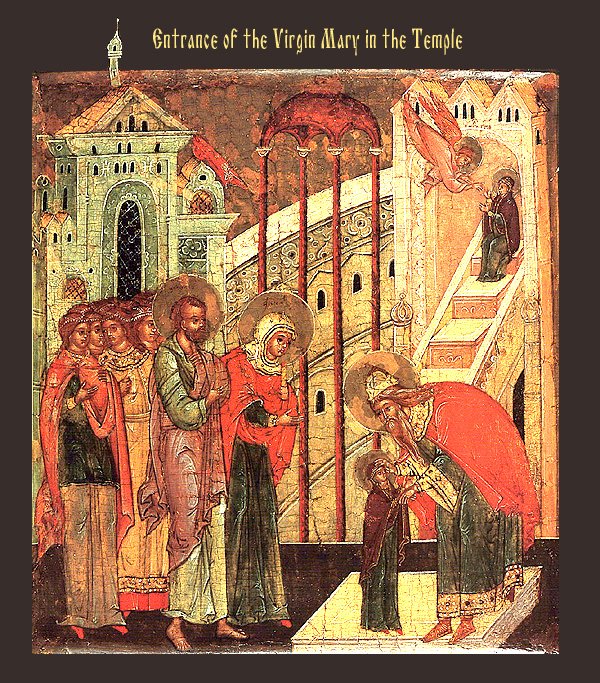
Forefeast of Entry
Today we celebrate the Forefeast of the Entry of the Most Holy Theotokos into the Temple, and tomorrow is the Feast Day itself. A Forefeast is one or more days preceding certain major holidays, in order to prepare the faithful for the celebration of the actual Feast Day. In the Services, hymns describing the festive event are sung.
Today we celebrate the Forefeast of the Entry of the Most Holy Theotokos into the Temple, and tomorrow is the Feast Day itself. A Forefeast is one or more days preceding certain major holidays, in order to prepare the faithful for the celebration of the actual Feast Day. In the Services, hymns describing the festive event are sung.
According to Tradition, the righteous Joachim and Anna, the parents of the Virgin Mary, vowed to dedicate their child to God. When the girl was three years old, her parents brought her to the Temple at Jerusalem holding candles and singing Psalms.
Psalm 44/45: 10-17 foreshadows this event:
"Hear, O daughter, and see, and incline your ear; forget also your people and your father’s house. Because the king has desired your beauty; for he is your Lord. And the daughter of Tyre shall adore with gifts; the rich of the people of the land shall supplicate your countenance. All her glory is that of the daughter of the king of Esebon, robed as she is golden fringed garments, in embroidered clothing; virgins shall be be brought to the king after her, her fellows shall be brought to you. They shall be brought with gladness and exaltation; they shall be led into the king's temple. Instead of your fathers children are born to you; you shall make them princes over all the earth. They shall make mention of your name from generation to generation; therefore shall the nations shall confess you for ever, even forever and ever
She was met by the priests of the Temple and the High Priest Zachariah himself. With no help from anyone else, the girl walked up fifteen steps. Zachariah, the father of Saint John the Baptist, took the Virgin Mary into the Holy of Holies: the most sacred place in the Temple, where she remained until at the age of twelve, when she was betrothed to Saint Joseph. No one could enter there except the High Priest, who entered alone once a year (on the Day of Atonement) to offer the blood of sacrificial animals "for himself, and for the errors of the people" (Hebrews 9:7). But Zachariah was given an extraordinary inspiration for his action. After all, the Virgin herself was to become the Holy of Holies, a living temple, bearing in her womb the Savior of the world.
Troparion - Tone 4
Today Anna bequeaths gladness to all instead of sorrow by bringing forth her fruit,1 the only ever-Virgin. / Today, in fulfillment of her vow, / joyfully she brings her into the Temple of the Lord / as the true Temple and pure Mother of God the Word.1 James 5:18
Kontakion - Tone 4
Today Anna bequeaths gladness to all instead of sorrow by bringing forth her fruit,1 the only ever-Virgin. / Today, in fulfillment of her vow, / joyfully she brings her into the Temple of the Lord / as the true Temple and pure Mother of God the Word.
Ven. Gregory Decapolites
He was born in Irenopolis, one of the “Ten Cities” of Asia Minor. Though his parents wanted him to marry, he entered monastic life as a young man, and struggled for many years, living in reclusion under the guidance of a wise spiritual father. One day, while in prayer, he was carried away to Paradise and experienced the blessedness that the redeemed will know at the general Resurrection. The
He was born in Irenopolis, one of the “Ten Cities” of Asia Minor. Though his parents wanted him to marry, he entered monastic life as a young man, and struggled for many years, living in reclusion under the guidance of a wise spiritual father. One day, while in prayer, he was carried away to Paradise and experienced the blessedness that the redeemed will know at the general Resurrection. The vision seemed to him only to last for an hour, but he learned from his disciple that he had been in ecstasy for four days.
Aware that the Enemy can appear as an angel of light, and that we should be suspicious of seeming revelations, he sought the counsel of his Abbot, who reassured him, and told him to give thanks to God by continuing in his ascetic labors.
Soon, he was told by revelation that he was to go forth into the world, living without an earthly home, to uphold the Orthodox faith, which was then under attack by the Iconoclasts. He traveled through Ephesus, Constantinople, Corinth, Rome, Sicily, Thessalonica, and Constantinople again, laboring in defense of the Faith and working many miracles. Usually he would stay with poor people who welcomed him into their houses, though it was forbidden by law to receive an Orthodox monk (that is, one who defended the Icons). In his last few years, afflicted by illness, he settled in Constantinople, where he reposed in peace in 832, just before the end of iconoclasm and the restoration of Orthodoxy. Since 1490, his incorrupt relics have dwelt at the Monastery of Bistritsa in Romania, where they continue to be a source of miracles for the many pilgrims who come to venerate them.
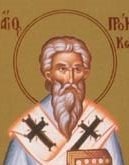
Our Holy Father Proclus, Archbishop of Constantinople (447)
He was a disciple and scribe of St John Chrysostom. About the year 426 he was ordained Bishop of Cyzicus, but was unable to take up his see because another had been unlawfully elected in his place, so he remained in Constantinople. Around 428, Nestorius was made Patriarch of Constantinople, and almost immediately began teaching his blasphemous doctrine that the holy Virgin could not be called Theotokos, “God-bearer,” but only Christotokos, “Christ-bearer.” Proclus resisted this teaching forcefully, once giving a sermon in the presence of the heretical Patriarch, defending the Orthodox teaching concerning the Theotokos. Proclus
He was a disciple and scribe of St John Chrysostom. About the year 426 he was ordained Bishop of Cyzicus, but was unable to take up his see because another had been unlawfully elected in his place, so he remained in Constantinople. Around 428, Nestorius was made Patriarch of Constantinople, and almost immediately began teaching his blasphemous doctrine that the holy Virgin could not be called Theotokos, “God-bearer,” but only Christotokos, “Christ-bearer.” Proclus resisted this teaching forcefully, once giving a sermon in the presence of the heretical Patriarch, defending the Orthodox teaching concerning the Theotokos. Proclus was elevated to the throne of Patriarch of Constantinople in 434, after Nestorius had been deposed and the Orthodox teaching clearly proclaimed in an Ecumenical Council. It was Proclus who persuaded the Emperor Theodosius the Younger to have the holy relics of his teacher St John Chrysostom returned to Constantinople, and who received them on their triumphal return to the city. He reposed in peace in 447.
Troparion - Tone 4
The twofold lamps of divine gifts, / Proclus, shepherd of New Rome, and Gregory, scion of Decapolis, / guide us by the light of grace as divinely-inspired fathers. / Let us draw near and eagerly beseech them, / that we may receive forgiveness and salvation of our souls.
Kontakion - Tone 4
Today with the most revered of all cities / we fittingly celebrate your honored translation to heaven, / Father of Fathers, wise Proclus.
Scripture Readings
☩Epistle
2 Thessalonians 3:6-18
6
Now we command you, brethren, in the name of our Lord Jesus Christ, that ye withdraw yourselves from every brother that walketh disorderly, and not after the tradition which he received of us.
7
For yourselves know how ye ought to follow us: for we behaved not ourselves disorderly among you;
8
Neither did we eat any man’s bread for nought; but wrought with labour and travail night and day, that we might not be chargeable to any of you:
9
Not because we have not power, but to make ourselves an ensample unto you to follow us.
10
For even when we were with you, this we commanded you, that if any would not work, neither should he eat.
11
For we hear that there are some which walk among you disorderly, working not at all, but are busybodies.
12
Now them that are such we command and exhort by our Lord Jesus Christ, that with quietness they work, and eat their own bread.
13
But ye, brethren, be not weary in well doing.
14
And if any man obey not our word by this epistle, note that man, and have no company with him, that he may be ashamed.
15
Yet count him not as an enemy, but admonish him as a brother.
16
Now the Lord of peace himself give you peace always by all means. The Lord be with you all.
17
The salutation of Paul with mine own hand, which is the token in every epistle: so I write.
18
The grace of our Lord Jesus Christ be with you all. Amen. The second epistle to the Thessalonians was written from Athens.
☩Gospel
Luke 16:15-18, 17:1-4
15
And he said unto them, Ye are they which justify yourselves before men; but God knoweth your hearts: for that which is highly esteemed among men is abomination in the sight of God.
16
The law and the prophets were until John: since that time the kingdom of God is preached, and every man presseth into it.
17
And it is easier for heaven and earth to pass, than one tittle of the law to fail.
18
Whosoever putteth away his wife, and marrieth another, committeth adultery: and whosoever marrieth her that is put away from her husband committeth adultery.
1
Then said he unto the disciples, It is impossible but that offences will come: but woe unto him, through whom they come!
2
It were better for him that a millstone were hanged about his neck, and he cast into the sea, than that he should offend one of these little ones.
3
Take heed to yourselves: If thy brother trespass against thee, rebuke him; and if he repent, forgive him.
4
And if he trespass against thee seven times in a day, and seven times in a day turn again to thee, saying, I repent; thou shalt forgive him.
Liturgical data sourced from OCA.org and orthocal.info