Fasting Rules
 Meat
Allowed
 Fish
Allowed
 Dairy
Allowed
 Oil
Allowed
 Wine
Allowed
Saints & Commemorations
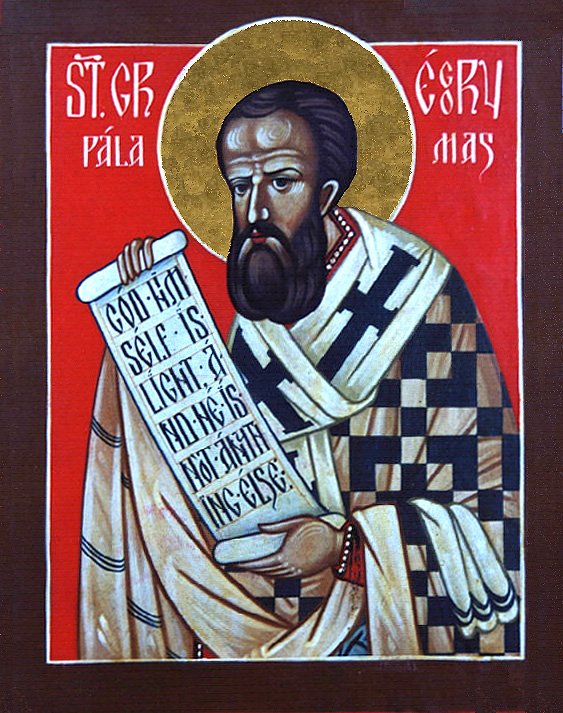
St Gregory Palamas (1359)
The teaching of St Gregory is so fundamental to Orthodoxy that he is especially commemorated each year in Great Lent on the Sunday following the Sunday of Orthodoxy (as well as on Nov. 14); Bishop Kallistos observes in the English edition of the Philokalia, “his successful defence of the divine and uncreated character of the light of Tabor…[is] seen as a direct continuation of the preceding celebration, as nothing less than a renewed Triumph of Orthodoxy.”
The son of a prominent family, St Gregory was born (1296) and raised in Constantinople. At ab
The teaching of St Gregory is so fundamental to Orthodoxy that he is especially commemorated each year in Great Lent on the Sunday following the Sunday of Orthodoxy (as well as on Nov. 14); Bishop Kallistos observes in the English edition of the Philokalia, “his successful defence of the divine and uncreated character of the light of Tabor…[is] seen as a direct continuation of the preceding celebration, as nothing less than a renewed Triumph of Orthodoxy.”
The son of a prominent family, St Gregory was born (1296) and raised in Constantinople. At about age twenty, he abandoned a promising secular career to become a monk on Mt Athos. (His family joined him en masse: two of his brothers went with him to the Holy Mountain; at the same time his widowed mother, two of his sisters, and many of the household servants also entered monastic life.) He spent the next twenty years living as a hermit, spending five days a week in complete solitude, then joining the brethren on weekends for the Divine Liturgy and its accompanying services.
Around 1335 he was called to live a much more public life in defense of the faith and spirituality of the Church. A Greek living in Italy, Barlaam the Calabrian, had launched an attack on the hesychastic spirituality of the Church. Fundamentally, Barlaam denied that man can attain to a true vision of God Himself, or true union with Him, in this life. Gregory, recognizing in this an attack on the Christian faith itself, responded. He even left the Holy Mountain and re-settled in Constantinople so as better to wage the struggle, which had become so public that a Church Council was called to settle the issue. St Gregory’s views were affirmed, and Barlaam’s condemned, at the Council of Constantinople of 1341.
Though Barlaam himself returned to Italy, a series of his followers continued the attack, eventually resulting in two more Councils in 1347 and 1351, both of which affirmed the hesychasts’ position. Metropolitan Hierotheos (The Mind of the Orthodox Church) writes that these councils have “all the marks of an Ecumenical Council.” This, along with the fact that St Gregory’s views are affirmed in the Synodikon of Orthodoxy (appointed to be read in churches every Sunday of Orthodoxy), and his commemoration every second Sunday of Great Lent, makes clear that his teaching is a basic and indispensable part of the Orthodox Faith.
In 1347 St Gregory was consecrated Metropolitan of Thessaloniki, where he served until his repose. (He spent a year of this period as the prisoner of Turkish pirates). Despite (or due to?) his austere monastic background, he was revered by his flock: immediately after his repose in 1359, popular veneration of him sprang up in Thessaloniki, Constantinople and Mt Athos and, in 1368, only nine years after his death, the Church officially glorified him as a saint.
St Gregory was always clear that unceasing mental prayer is not a special calling of monastics, but is possible and desirable for every Christian in every walk of life. See his On the Necessity of Constant Prayer for all Christians, reproduced on this site.
Troparion - Tone 8
O luminary of Orthodoxy, support and teacher of the Church, / ideal of monks and invincible
champion of theologians, / O wonderworker Gregory, boast of Thessalonika and herald of grace, /
always intercede for all of us that our souls may be saved.
Kontakion - Tone 8
Holy and divine instrument of wisdom, / radiant and harmonious trumpet of theology, / we praise you in song, O divinely-speaking Gregory. / As a mind standing before the Primal Mind, guide our minds to Him, Father, / so that we may cry aloud to you: “Rejoice, herald of grace.”
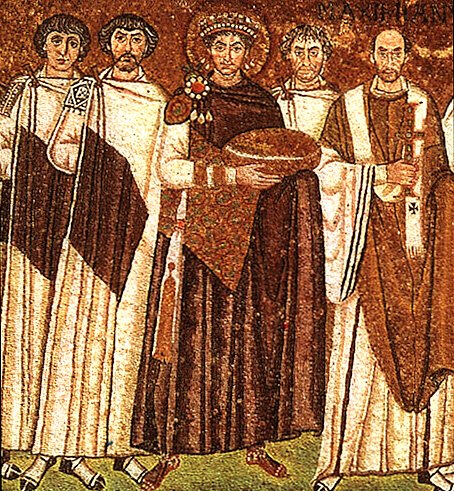
Pious Emperor Justinian and His Wife Theodora (565)
“The pious Emperor Justinian was a fervent Christian and a man of genius in every field. His long reign (527-65) was a decisive period in the history of the Empire from the administrative, diplomatic, military, economic, legal, cultural and ecclesiastical points of view. He was the real founder of the Christian Empire, who brought together again the old Roman Empire that had been torn to pieces by barbarian invaders. H
“The pious Emperor Justinian was a fervent Christian and a man of genius in every field. His long reign (527-65) was a decisive period in the history of the Empire from the administrative, diplomatic, military, economic, legal, cultural and ecclesiastical points of view. He was the real founder of the Christian Empire, who brought together again the old Roman Empire that had been torn to pieces by barbarian invaders. He believed that upholding the Orthodox faith and maintaining the symphony of Church and State were essential for the well-being of the Empire. He had a deep knowledge of theology and wrote several treatises on dogmas of the faith. He forbad pagan worship in the Empire, and was unremitting in pursuit of heretics and sectarians. He did all he could to reconcile the Monophysites to the Council of Chalcedon. In 553, he summoned to Constantinople the fifth Ecumentical Council (25 July), which reaffirmed the condemnation of Nestorius and also condemned Origen.
“The splendor of the churches and of everything that testified to the divine glory was brought to a culmination in the Empire of Justinian. He rebuilt the Great Church of Saint Sophia in Constantinople where, it was said, the service of God was so wonderfully ordered that it was as if heaven had come down to earth. He made great gifts to the monasteries of Egypt and of Palestine and built the Monastery of Saint Catherine at Mount Sinai. In all that he did, he had the help and support of his wife, the pious Empress Theodora. Justinian died on 14 November 565, without having been able to restore full unity to the Church, but he had set the Empire on firm foundations that would endure for centuries.” (Synaxarion)
It was Justinian who built the great Church of the Holy Wisdom (Agia Sophia), perhaps the most magnificent Christian church. The hymn “Only-begotten Son” was inserted in the Divine Liturgy at his command, and is thought to have been composed by him.
Note: There is some controversy about the inclusion of Justinian in the Synaxaria. His fervent labors to reconcile the Monophysites to the Church have led some writers to conclude that he himself embraced Monophysite errors; others dispute this. Lacking the wisdom to resolve the question, we only note that he is included in Ormylia Monastery’s Synaxarion (quoted above), but some Synaxaria have turned his commemoration into that of the Emperor Justin (518-527).
Holy Great New Martyr Constantine of Hydra
The Holy New Martyr Constantine was born on the island of Hydra; his father was named Michael, and his mother was called Marina. At the age of eighteen, he left Hydra and went to Rhodes, where he served the Turkish ruler Hasan Kapetan. There Constantine converted to Islam and took the name Hasan, in honor of his master.
The Holy New Martyr Constantine was born on the island of Hydra; his father was named Michael, and his mother was called Marina. At the age of eighteen, he left Hydra and went to Rhodes, where he served the Turkish ruler Hasan Kapetan. There Constantine converted to Islam and took the name Hasan, in honor of his master. For three years he received great honors and was content.
Later, however, he felt remorse for denying Christ. He gave alms to Orthodox Christians, prayed with bitter tears, and showed great reverence to the Orthodox priests he encountered. He decided to atone for his sin by martyrdom. So he found a Spiritual Father, to whom he confessed, asking for his blessing to seek martyrdom. Seeing how young he was, his Spiritual Father advised him to wait. Constantine obeyed and left Rhodes, traveling to the city of Krimi, then to Constantinople, and from there he went to the Holy Mountain.
At Ivḗron Monastery he prepared himself for martyrdom. With the blessing of the Fathers, he returned to Rhodes and presented himself to the ruler, and courageously confessed Christ. The tortures he endured were horrible. Finally, he was hanged on November 14, 1800.
Today, at Saint Constantine's birthplace on Hydra, there is a beautiful church which is dedicated to him, and there his holy relics are kept.
A fragment from Saint Constantine's relics is in the "Quick to Hear" Icon at Saint Tikhon's Monastery church in Pennsylvania.
Troparion - Tone 4
Your holy martyr, Constantine, O Lord, / through his sufferings has received an incorruptible crown from You, our God. / For having Your strength, he laid low his adversaries, / and shattered the powerless boldness of demons. / Through his intercessions, save our souls!
Holy Apostle Philip
Scripture Readings
☩Epistle
2 Corinthians 11:1-6
1
Would to God ye could bear with me a little in my folly: and indeed bear with me.
2
For I am jealous over you with godly jealousy: for I have espoused you to one husband, that I may present you as a chaste virgin to Christ.
3
But I fear, lest by any means, as the serpent beguiled Eve through his subtilty, so your minds should be corrupted from the simplicity that is in Christ.
4
For if he that cometh preacheth another Jesus, whom we have not preached, or if ye receive another spirit, which ye have not received, or another gospel, which ye have not accepted, ye might well bear with him.
5
For I suppose I was not a whit behind the very chiefest apostles.
6
But though I be rude in speech, yet not in knowledge; but we have been throughly made manifest among you in all things.
☩Gospel
Luke 9:37-43
37
And it came to pass, that on the next day, when they were come down from the hill, much people met him.
38
And, behold, a man of the company cried out, saying, Master, I beseech thee, look upon my son: for he is mine only child.
39
And, lo, a spirit taketh him, and he suddenly crieth out; and it teareth him that he foameth again, and bruising him hardly departeth from him.
40
And I besought thy disciples to cast him out; and they could not.
41
And Jesus answering said, O faithless and perverse generation, how long shall I be with you, and suffer you? Bring thy son hither.
42
And as he was yet a coming, the devil threw him down, and tare him. And Jesus rebuked the unclean spirit, and healed the child, and delivered him again to his father.
43
And they were all amazed at the mighty power of God. But while they wondered every one at all things which Jesus did, he said unto his disciples,
Liturgical data sourced from OCA.org and orthocal.info