Fasting Rules
 Meat
Abstain
 Fish
Allowed
 Dairy
Abstain
 Oil
Allowed
 Wine
Allowed
Saints & Commemorations
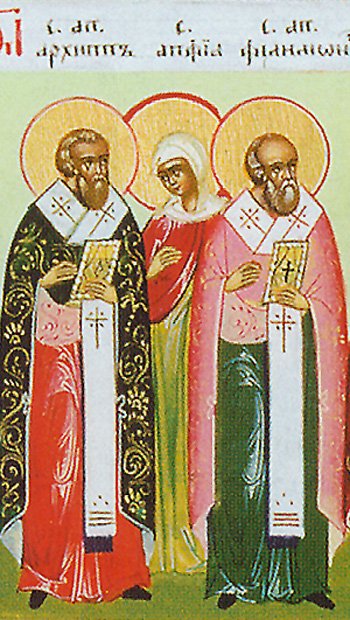
Apostles of the 70 Philemon, Archippus, Apphia, and Onesimus
Philemon is addressed in the Epistle of the holy Apostle Paul that bears his name. He was a nobleman from Colossae; Apphia was his wife. Archippus was Bishop of Colossae. All three were disciples of the Apostle Paul. Onesimus was a pagan slave of Philemon, who stole from his master and fled to Rome. There St Paul led him to faith in Christ, and wrote the Epistle to Philemon, urging Onesimus’ master to forgive him and take him back as a brother in Christ. T
Philemon is addressed in the Epistle of the holy Apostle Paul that bears his name. He was a nobleman from Colossae; Apphia was his wife. Archippus was Bishop of Colossae. All three were disciples of the Apostle Paul. Onesimus was a pagan slave of Philemon, who stole from his master and fled to Rome. There St Paul led him to faith in Christ, and wrote the Epistle to Philemon, urging Onesimus’ master to forgive him and take him back as a brother in Christ. This Philemon did, and Onesimus later became a bishop. In Greece he is venerated as the patron Saint of the imprisoned. All of these holy followers of Christ died as martyrs, stoned to death by pagans.
Troparion - Tone 3
Holy Apostles Philemon, Archippus, Apphia, and Onesimus, / entreat the merciful God / to grant our souls forgiveness of transgressions.
Kontakion - Tone 2
Let us praise the Apostles of Christ, / who illumine the ends of the earth like all-radiant stars: / glorious Philemon and dedicated Archippus, / Onesimus, together with Mark and Apollos, and the all-wise Apphia. / Let us cry to them: / “Unceasingly pray for us all!”
Apostles of the 70 Philemon, Archippus, Apphia
Philemon is addressed in the Epistle of the holy Apostle Paul that bears his name. He was a nobleman from Colossae; Apphia was his wife. Archippus was Bishop of Colossae. All three were disciples of the Apostle Paul. Onesimus was a pagan slave of Philemon, who stole from his master and fled to Rome. There St Paul led him to faith in Christ, and wrote the Epistle to Philemon, urging Onesimus’ master to forgive him and take him back as a brother in Christ. T
Philemon is addressed in the Epistle of the holy Apostle Paul that bears his name. He was a nobleman from Colossae; Apphia was his wife. Archippus was Bishop of Colossae. All three were disciples of the Apostle Paul. Onesimus was a pagan slave of Philemon, who stole from his master and fled to Rome. There St Paul led him to faith in Christ, and wrote the Epistle to Philemon, urging Onesimus’ master to forgive him and take him back as a brother in Christ. This Philemon did, and Onesimus later became a bishop. In Greece he is venerated as the patron Saint of the imprisoned. All of these holy followers of Christ died as martyrs, stoned to death by pagans.
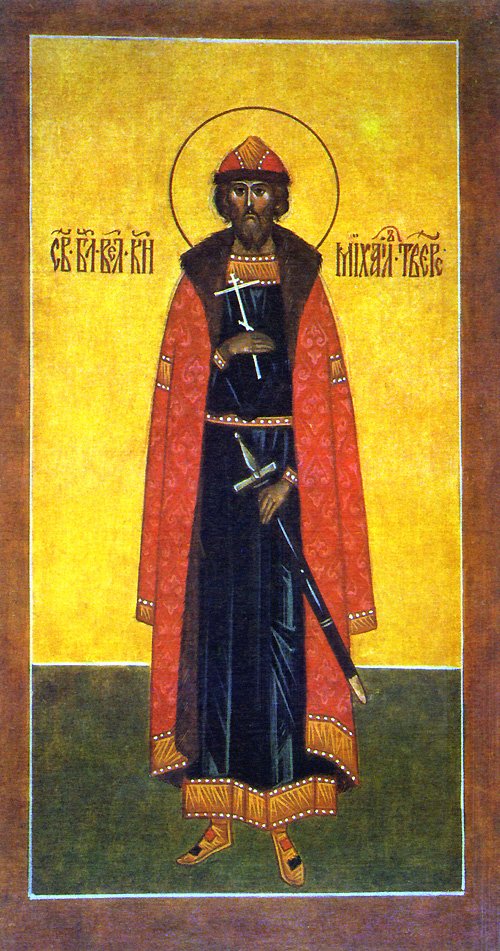
St Michael, Prince of Tver
He was born in Tver in 1272 to Prince Yaroslav Yaroslavovich, who was the brother of St Alexander Nevsky (November 23). Michael was brought up in the faith by his mother, who later became a nun. Such was his fervor that from childhood he was certain that he must end his life either as a monk or a martyr.
He was born in Tver in 1272 to Prince Yaroslav Yaroslavovich, who was the brother of St Alexander Nevsky (November 23). Michael was brought up in the faith by his mother, who later became a nun. Such was his fervor that from childhood he was certain that he must end his life either as a monk or a martyr. He succeeded his brother as Prince of Tver in 1285, and later became Grand Prince of Vladimir, the Russian capital during the Mongol conquest.
When Prince Michael lost the throne of Vladimir through the plotting of his kinsman Prince George, his advisers urged him to go to war against George; but he preferred to lose power rather than to subject his people to bloodshed. When George attacked Tver itself, Michael took up arms to defend it, and was victorious. One of his prisoners was Princess Agatha, George’s wife and the sister of the Tatar Khan. When she died in captivity, the full wrath of both George and the Tatars was aroused against Michael. The Prince knew that the only way to avert catastrophe for his people was to go to the Golden Horde to be judged at the Khan’s court. Michael’s kinsmen and advisors knew that such a course would surely lead to his death, but none were able to dissuade him from going to save his people.
Michael was kept prisoner with a wooden yoke around his neck, and subjected to many humiliations by the Tatars. But as he awaited his sentence he remained calm, spending his days in chanting the Church services and the Psalms. On the night of 21-22 November he had a revelation of his impending death. He attended the Liturgy, took Communion, and embraced his family. Then, opening the Psalter, he read the words Cast thy burden on the Lord, and He will sustain thee: He will never permit the righteous to be moved (Ps 54). He then calmly greeted his kinsman George and his minions, who pounced on the Prince and ran him through with swords. Prince Michael’s relics were returned to Moscow, then translated to Tver in 1320. When the city was besieged in 1549, St Michael appeared to the inhabitants in the form of a mounted knight, armed for battle.
Troparion - Tone 8
Elevating your mind to God and desiring to live together with the Angels, / you forsook the perishable glory of the earth, O blessed one. / You laid down your life for your people, and received a crown for your labors. / O divinely-wise Michael, pray to Christ God for those who lovingly honor your holy memory.
Kontakion - Tone 2
Seeking the highest glory, you have tinged God's Church with your blood, / and suffered for her, O Saint Michael, gladly accepting an unjust death. / Therefore, standing with the Angels before Christ God, / pray incessantly for all of us.
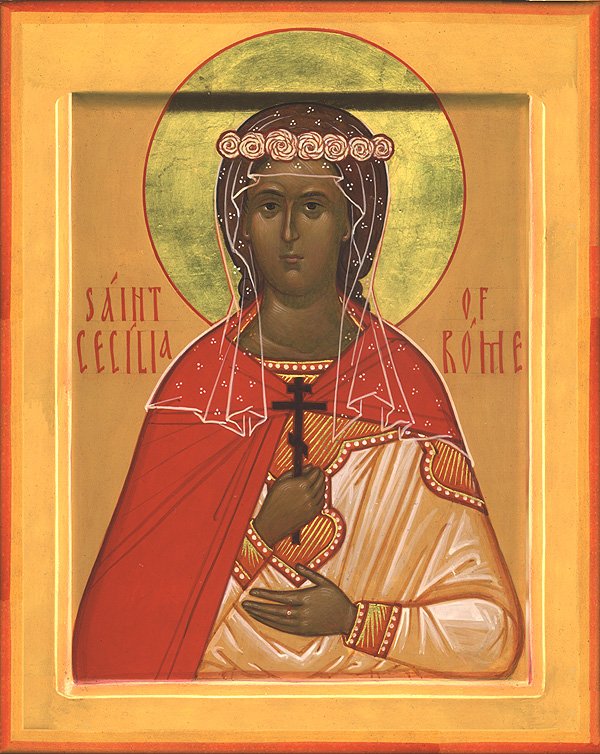
Holy Martyrs Cecilia, Valerian, Tiburtius and Maximus, at Rome (3rd c.)
Saint Cecilia was born to a prominent pagan family in Rome. In her youth she secretly became a disciple of Christ. When her parents betrothed her to a young man named Valerian, she brought him to faith in Christ and persuaded him that they should live in virginity. Valerian was baptised by Pope Urban, and in his turn went on to bring his brother Tiburtius to the Faith.
Saint Cecilia was born to a prominent pagan family in Rome. In her youth she secretly became a disciple of Christ. When her parents betrothed her to a young man named Valerian, she brought him to faith in Christ and persuaded him that they should live in virginity. Valerian was baptised by Pope Urban, and in his turn went on to bring his brother Tiburtius to the Faith. At the time, Christians in Rome were being violently persecuted, many to the point of martyrdom; Cecilia, her husband, and his brother made it their work to go out by night and secretly give pious burial to the martyrs and give charitable help to their families. Eventually, this was discovered, and the two brothers were in their own turn arrested and condemned as Christians. At the moment of their beheading, the Roman officer Maximus saw heaven open and angels come to receive their souls; he, along with several other onlookers, confessed Christ, and in his turn died under torture. Finally, Cecilia herself was arrested and, after faithfully enduring various tortures, was beheaded. Because St Cecilia is described in her first biography as a lover of music, she is honored as patroness of church music in the West, and is often shown playing the organ.
Troparion - Tone 3
In the radiance of your divine way of life, / you were drawn toward everlasting life, attracting a pair of brothers as well. / In harmony with them, Cecilia, you struggled and became worthy of divine glory. / With them, intercede that those who praise you / may be granted pardon of their transgressions and great mercy.
Kontakion - Tone 4
Let us, the plenitude of the faithful, / sing hymns to her who was freely espoused to Christ, / and adorned her heart with virtues befitting God. / Then, shining like the sun, / she vanquished the boldness of Almachius in the midst of those who sought her. / After these things, she was seen by those on earth / as a divine foundation, strengthening their faith.
Kallistos Xanthopoulos, Patriarch of Constantinople
Saint Kallistos (Kállistos) lived a life of asceticism at the Magul Skete on Mount Athos (opposite Philotheou Monastery), abiding there for twenty-eight years. He was a disciple of Saint Gregory of Sinai (August 8), whose Life he wrote.
He became closely acquainted with Saint Ignatius Xanthopoulos, who was born in Constantinople.
Saint Kallistos (Kállistos) lived a life of asceticism at the Magul Skete on Mount Athos (opposite Philotheou Monastery), abiding there for twenty-eight years. He was a disciple of Saint Gregory of Sinai (August 8), whose Life he wrote.
He became closely acquainted with Saint Ignatius Xanthopoulos, who was born in Constantinople. They have been described as two bodies united with one soul, in a spiritual sense, for both were godly-minded and attained great heights of noetic prayer. According to Saint Symeon of Thessaloniki (September 15), Kállistos and Ignatius Xanthopoulos beheld the Uncreated Light, just as the Apostles had on Mount Tabor, and their faces seemed to “shine like the sun.” Together they wrote the "Directions to Hesychasts in One Hundred Chapters," a treatise in 100 sections on the ascetical practices of the Hesychast monks. This was incorporated into the Philokalia of the Wakeful Fathers by Saint Nikodemos the Hagiorite, and it had a profound influence on Orthodox spirituality.
In 1397 Saint Kállistos was elevated to the patriarchal throne, but for only three months during the reign of Manuel Paleologos (1391-1425). He agreed to travel to Serbia in order to bring peace to that church, stopping along the way at Mount Athos. There Saint Maximos Kavsokalyvites (January 13) predicted: "This Elder shall not see his flock again, for the funeral dirge, "Blessed are the blameless in the way" (Psalm 118/119:1) is sounding behind him.
When he reached Serbia, Saint Kállistos exchanged this temporal life for everlasting life.
Troparion - Tone 4
The truth of things revealed you to your flock as a rule of faith, / a model of meekness, and a teacher of temperance. / Therefore, through humility, you attained the heights; / and through poverty, riches. / O Hierarch Kállistos our Father, entreat Christ God that our souls may be saved.
Kontakion - Tone 2
O Hierarch Kállistos, divine thunder, spiritual trumpet, / planter of faith, and pruner of heresies, / great favorite of the Trinity, / as you stand before God with the Angels, pray unceasingly for all of us.
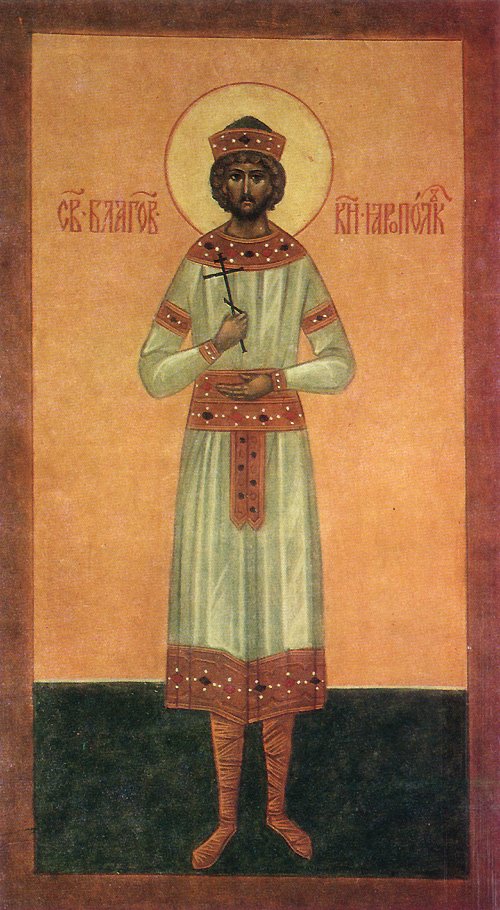
Holy Prince and Passion-Bearer Peter Yaropolk (1086)
“Saint Peter Yaropolk, the son of Grand Prince Iziaslav Yaroslavovich, took part in all his father’s campaigns as an obedient son, and went with him into exile. The meek and humble Prince had much to suffer from the members of his family, but he always forgave them. Every day he earnestly prayed to be counted worthy of holy death, like Saints Boris and Gleb (24 July), in order to be cleansed of his many sins by the shedding of his blood and to be freed from the vanity of this world. He
“Saint Peter Yaropolk, the son of Grand Prince Iziaslav Yaroslavovich, took part in all his father’s campaigns as an obedient son, and went with him into exile. The meek and humble Prince had much to suffer from the members of his family, but he always forgave them. Every day he earnestly prayed to be counted worthy of holy death, like Saints Boris and Gleb (24 July), in order to be cleansed of his many sins by the shedding of his blood and to be freed from the vanity of this world. He was assasinated on 21 November 1086.” (Synaxarion)
The term ‘Passion-bearer’ is used in the Russian Church for Saints who, though they were not killed for their faith and are thus not strictly Martyrs, suffered death with resignation and in the spirit of the Gospel. Saints Boris and Gleb are the first and model Passion-bearers.
Scripture Readings
☩Epistle
Ephesians 4:1-6
1
I therefore, the prisoner of the Lord, beseech you that ye walk worthy of the vocation wherewith ye are called,
2
With all lowliness and meekness, with longsuffering, forbearing one another in love;
3
Endeavouring to keep the unity of the Spirit in the bond of peace.
4
There is one body, and one Spirit, even as ye are called in one hope of your calling;
5
One Lord, one faith, one baptism,
6
One God and Father of all, who is above all, and through all, and in you all.
☩Gospel
Luke 12:16-21
16
And he spake a parable unto them, saying, The ground of a certain rich man brought forth plentifully:
17
And he thought within himself, saying, What shall I do, because I have no room where to bestow my fruits?
18
And he said, This will I do: I will pull down my barns, and build greater; and there will I bestow all my fruits and my goods.
19
And I will say to my soul, Soul, thou hast much goods laid up for many years; take thine ease, eat, drink, and be merry.
20
But God said unto him, Thou fool, this night thy soul shall be required of thee: then whose shall those things be, which thou hast provided?
21
So is he that layeth up treasure for himself, and is not rich toward God.
Liturgical data sourced from OCA.org and orthocal.info