Fasting Rules
 Meat
Abstain
 Fish
Abstain
 Dairy
Abstain
 Oil
Abstain
 Wine
Abstain
Saints & Commemorations
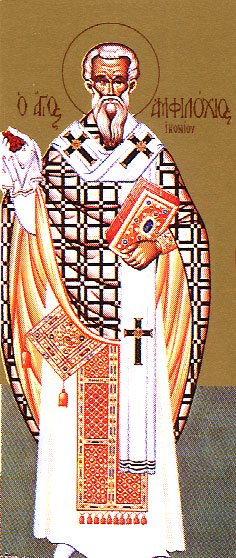
Our Holy Father Amphilocus, Bishop of Iconium (395)
“A fellow-countryman and friend of St Basil the Great and other great saints of the fourth century, Amphilochius early forsook the bustle of the world and withdrew to a cave where, as a solitary, he lived in asceticism for forty years. The episcopal throne in Iconium then fell empty, and Amphilochius was chosen in a wonderful way and consecrated as Bishop of Iconium. H
“A fellow-countryman and friend of St Basil the Great and other great saints of the fourth century, Amphilochius early forsook the bustle of the world and withdrew to a cave where, as a solitary, he lived in asceticism for forty years. The episcopal throne in Iconium then fell empty, and Amphilochius was chosen in a wonderful way and consecrated as Bishop of Iconium. He was a marvellous shepherd and a great defender of the purity of the Orthodox faith, and took part in the Second Ecumenical Council in 381. He fought zealously against Macedonius, and against the Arians and the Eunomians. He personally begged Theodosius the Great to drive the Arians out of every city in the Empire, but the Emperor did not comply with his request. After a few days, Amphilochius came before the Emperor again. When the bishop was taken into the presence-chamber, the Emperor was sitting on his throne with his son Arcadius, whom he had taken as co-Emperor, sitting at his right hand. Entering the room, Amphilochius did reverence to Theodosius, but ignored Arcadius as though he were not there. Infuriated by this, the Emperor Theodosius commanded that Amphilochius be instantly driven from court. The saint then said to the Emperor: ‘Do you see, 0 Emperor, how you do not tolerate a slight paid to your son? In the same way, God the Father does not tolerate dishonour paid to His Son, turning with loathing from those who blaspheme against Him, and being angered at that accursed Arian heresy.’ Hearing this, the Emperor understood the reason for Amphilochius’s seeming disrespect towards his son, and marvelled at his wisdom and daring. Among many other works, Amphilochius wrote several books on the Faith. He entered into rest in 395 in great old age, and went to immortal life.” (Prologue)
Saint Amphilocus was a kinsman of St Gregory the Theologian: his father’s sister Nonna (August 5) was St Gregory’s mother. Amphilocus himself was a lifelong friend of all three of the great Cappadocian Fathers: Sts Basil, Gregory the Theologian and Gregory of Nyssa.
Troparion - Tone 4
The truth of things revealed you to your flock as a rule of faith, / a model of meekness, and a teacher of temperance. / Therefore, through humility, you attained the heights; / and through poverty, riches. / O Hierarch Amphilókhios our Father, entreat Christ God that our souls may be saved.
Kontakion - Tone 2
O Hierarch Amphilókhios, / divine thunder, spiritual trumpet, / planter of faith, and pruner of heresies, / great favorite of the Trinity, / as you stand before God with the Angels, / pray unceasingly for all of us.
St Columban, Abbot of Luxeuil (615)
Born in Ireland around 540, he joined the great monastic movement that flowered in Ireland following the missionary work of St Patrick and his disciples. After spending some years in Irish monasteries, he made pilgrimage to Gaul with twelve other monks, planning to preach the Gospel wherever they were led.
Born in Ireland around 540, he joined the great monastic movement that flowered in Ireland following the missionary work of St Patrick and his disciples. After spending some years in Irish monasteries, he made pilgrimage to Gaul with twelve other monks, planning to preach the Gospel wherever they were led. The king of Burgundy, learning of their holiness, gave them land, where in time three large monasteries were founded with St Columban as their spiritual Father. Here the Saint established the rule that became normal for many monasteries in the West: in addition to its severe penitential disciplines, it included provision for some monks to be in prayer at every hour of the day and night — laus perennis (unceasing praise), as it was called. (This practice was also adopted by the Monastery of the Unsleeping Ones (Akoimetoi) in Constantinople). Eventually, political strife in Gaul led to the expulsion of the Irish monks, and Columban made his way to Italy through Germany, proclaiming the Gospel, instructing his spiritual children by letter, and battling against Arianism, which flourished throughout the Germanic lands. He settled in a monastery in the Appenines, where he reposed in peace in 615.
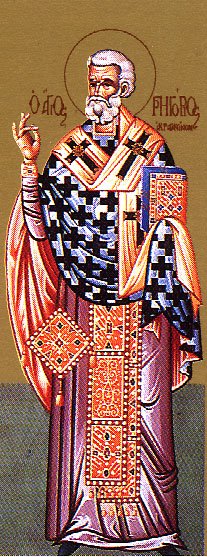
Gregory, Bishop of Agrigentum
Saint Gregory, Bishop of Agrigentum, was born on the island of Sicily, in the village of Pretorium, not far from the city of Agrigentum, of the pious parents Chariton and Theodota. The infant Gregory was baptized by the bishop of Agrigentum, Pataimonus. At ten years of age the studious boy mastered writing and was able to read, and to sing church hymns.
Saint Gregory, Bishop of Agrigentum, was born on the island of Sicily, in the village of Pretorium, not far from the city of Agrigentum, of the pious parents Chariton and Theodota. The infant Gregory was baptized by the bishop of Agrigentum, Pataimonus. At ten years of age the studious boy mastered writing and was able to read, and to sing church hymns. At twelve years of age Saint Gregory was given to the clergy, and he was put under the spiritual guidance of the archdeacon Donatus. Saint Gregory spent the next ten years in the Agrigentum church. Then, however, an angel of the Lord appeared to the holy youth, who had a fervent desire to visit Jerusalem, and said that God had blessed his intention.
At Jerusalem Saint Gregory was presented to Patriarch Macarius (563-574), who retained the pious youth for service in his own cathedral church, ordaining him deacon. The soul of Saint Gregory thirsted for monastic labors, and the Patriarch gave his blessing, allowing him go to a monastery on the Mount of Olives. After a year Saint Gregory departed this monastery for a desert Elder, who for four years taught him spiritual wisdom, humility and the principles of monastic life. The ascetic, foreseeing in Saint Gregory a future great luminary of the Church, gave him a blessing to forsake the solitary life.
Having left the Elder, Saint Gregory dwelt for a certain time at Jerusalem, and then went to Constantinople, where he was received with love by the brethren of the monastery of the holy Martyrs Sergius and Bacchus. The ascetic efforts of Saint Gregory were noticed by Patriarch Eutychius of Constantinople (552-565), at whose insistence the saint participated in the Fifth Ecumenical Council (553). At the completion of the Council Saint Gregory set off for Rome, to venerate the graves of the holy Apostles Peter and Paul.
During this time the bishop of Agrigentum died. The elder clergy and illustrious citizens of Agrigentum journeyed to Rome with a request for the Pope to determine a successor for their late hierarch from among a list of candidates they were presenting. The Pope, however, declined their proposal through divine inspiration, and instead summoned Saint Gregory to serve them as bishop.
For a few years Saint Gregory peacefully guided the flock entrusted to him by God. He was a defender of the down-trodden, a wise preacher, and miraculous healer. As archbishop, Saint Gregory led the life of an ascetic monk, fervently observing monastic vows. The flock loved their hierarch and trusted in him. But there were also malicious people who had resolved to slander him.
While Saint Gregory was in church, these vicious people secretly led a bribed harlot into his chambers, and then in front of the crowd which accompanied the bishop to the doors of his house after services, they led her out and accused Saint Gregory of the deadly sin of fornication. They placed the holy bishop under guard. The people attempted to defend their bishop, but were unsuccessful. At the trial the harlot gave false testimony against Saint Gregory. Just as she pronounced the words of slander, she went into a fit of frenzied rage. The judges accused the saint of sorcery. Saint Gregory was sent for judgment to the Roman bishop together with a report about his “crimes.”
The Pope, after reading the charges, did not want to see the accused, and gave orders to remand him to prison. The saint endured his humiliation humbly, dwelling in constant prayer. His prayerful effort and wonderworking gifts quickly became known through the city and the surrounding region. Pious Romans began to gather at the prison, whom the imprisoned saint taught about the righteous life, and he implored the Lord to heal the sick.
After two years, a clairvoyant Elder named Mark, who had known Saint Gregory since youth, came to the Pope. The Elder did not believe the charges and he persuaded the Pope to convene a Council to decide Gregory’s case. At the invitation of the Pope, many clergy from the city of Agrigentum came to the Council, together with all those making accusations against the saint, including the harlot. From Constantinople three bishops and the imperial dignitary Marcian came to Rome. Along the way Marcian had fallen grievously ill. On the advice of many people who had received healing through the prayers of Saint Gregory, servants carried the dying man to the prison where the wonderworking saint languished. Through the prayers of Saint Gregory the Lord granted healing to Marcian.
At the Council the slanderers attempted to renew their accusations, and as their chief proof they presented the deranged harlot to the judge, declaring that Gregory had bewitched her. But the saint prayed over her and cast out the devil. The woman came to her senses and told the Council the whole truth. The slanderers were brought to shame and judged. Marcian even wanted to execute them, but Saint Gregory implored forgiveness for them.
Saint Gregory returned in honor to his own cathedral, and surrounded by the love of his flock, he guided the Church until his own peaceful demise.
Troparion - Tone 4
O God of our Fathers, / always always act with kindness towards us; / take not Your mercy from us, / but guide our lives in peace / through the prayers of the hierarchs Gregory and Amphilochius.
Sisinios the Confessor
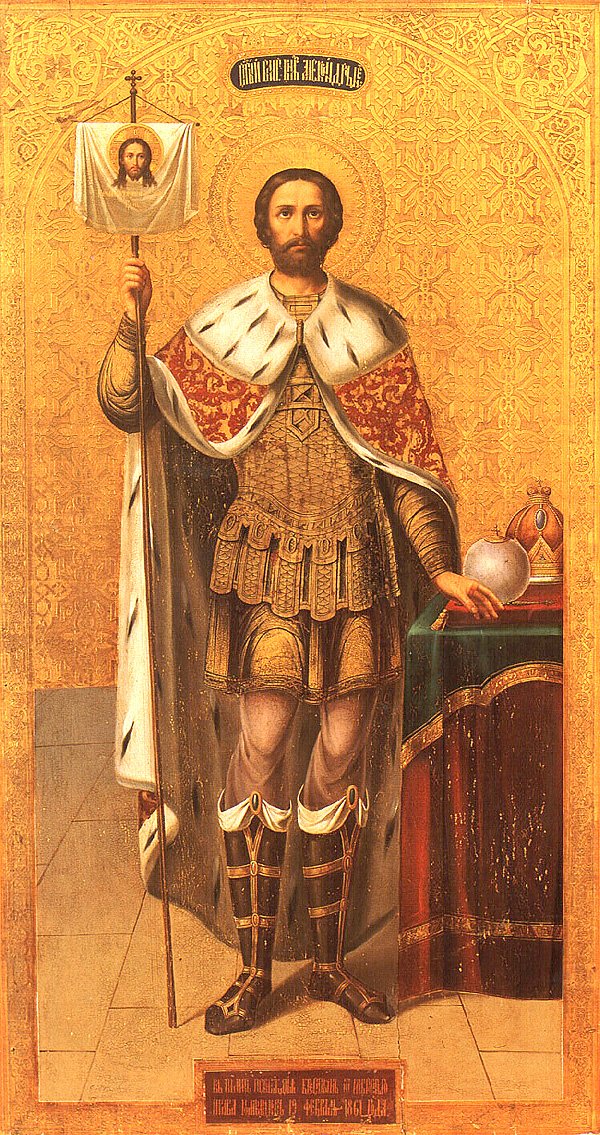
Rt. Blv. Great Prince Alexander Nevsky
The Holy Prince Alexander Nevsky was born on May 30, 1220 in the city of Pereslavl-Zalessk. His father Yaroslav II, Theodore in Baptism (+1246), “a gentle, kindly and genial prince”, was the younger son of Vsevolod III Large Nest (+ 1212), brother of the Holy Prince Yuri Vsevolodovich (February 4). Sai
The Holy Prince Alexander Nevsky was born on May 30, 1220 in the city of Pereslavl-Zalessk. His father Yaroslav II, Theodore in Baptism (+1246), “a gentle, kindly and genial prince”, was the younger son of Vsevolod III Large Nest (+ 1212), brother of the Holy Prince Yuri Vsevolodovich (February 4). Saint Alexander’s mother, Theodosia Igorevna, a Ryazan princess, was Yaroslav’s third wife. Their older son was the Holy Prince Theodore (June 5), who departed to the Lord at age fifteen. Saint Alexander was their second son.
His childhood was spent at Pereslavl-Zalessk, where his father was prince. The princely tonsure of the lad Alexander (a ceremony of initiation to be soldier) was done in the Savior Transfiguration Cathedral of Pereslavl by Saint Simon, Bishop of Suzdal (May 10), one of the compilers of the Kiev Caves Paterikon (Lives of the Fathers). From this Elder-hierarch, Saint Alexander received his first blessing for military service in the name of God, to defend the Russian Church and the Russian Land.
In 1227 Prince Yaroslav, at the request of the people of Novgorod, was sent by his brother Yuri, the Great Prince of Vladimir, to rule as prince in Novgorod the Great. He took with him his sons, Saints Theodore and Alexander. Dissatisfied with the Vladimir princes, the people of Novgorod soon invited Saint Michael of Chernigov (September 20), and in February 1229 Yaroslav with his sons departed to Pereslavl. The matter ended peacefully: in 1230 Yaroslav with his sons returned to Novgorod, and Saint Michael’s daughter Theodosia was betrothed to Saint Theodore, the elder brother of Saint Alexander. After the death of the bridegroom in 1233 the young princess went to a monastery and became famous in monastic exploits as the nun Saint Euphrosynē of Suzdal (September 25).
From his early years Saint Alexander went along on his father’s campaigns. In 1235 he participated in a battle at the River Emajogi (in present-day Estonia), where the forces of Yaroslav totally routed the Germans. In the following year Yaroslav went to Kiev, “settling” his son, Saint Alexander, to rule independently as prince at Novgorod. In 1239 Saint Alexander entered into marriage, taking as wife the daughter of the Polotsian prince Briacheslav. Some histories relate that the day the princess was baptized was the Name Day of her saintly spouse, and she was named Alexandra. His father, Yaroslav, blessed them at betrothal with the holy wonderworking icon of the Theodore Mother of God (the father was named Theodore in Baptism). Afterwards, Saint Alexander constantly prayed before this icon. Later, it was taken from the Gorodetsk Monastery, where he died, by his brother Basil of Kostroma (+1276), and transferred to Kostroma.
A very troublesome time had begun in Russian history: from the East came the Mongol Horde destroying everything in their path; from the West came the forces of the Teutonic Knights, which blasphemously and with the blessing of the Roman Pope, called itself “Cross-bearers” by wearing the Cross of the Lord. In this terrible hour the Providence of God raised up for the salvation of Russia holy Prince Alexander, a great warrior, man of prayer, ascetic and upholder of the Land of Russia. “Without the command of God there would not have been his prince.”
Abetted by the invasion of Batu, by the ruin of Russian cities, by the dismay and grief of the nation, by the destruction of its finest sons and leaders, a horde of crusaders made incursions into the borders of Russia. First were the Swedes. “A king of Roman faith from the midnight land,” Sweden, in 1240 gathered a great armed force and sent them to the Neva on many ships under the command of his son-in-law, Yarl (Prince) Birger. The haughty Swede sent his messengers to Novgorod to say to Saint Alexander: “Fight me if you have the courage, for I am already here and I am taking your land captive.”
Saint Alexander, then not yet twenty years old, prayed a long time in the church of Saint Sophia, the Wisdom of God. He recited the Psalm of David, saying: “Judge, O Lord, those who injure me, fight against those who fight against me. Take hold of shield and buckler, and rise up to help me” (Ps. 34/35). Archbishop Spyridon blessed the holy prince and his army for the battle. Leaving the church, Saint Alexander exhorted his troops with words of faith: “The power of God is not in numbers, but in truth.” With a smaller force, trusting in the Holy Trinity, the prince hastened towards the enemy to await help from his father, not knowing whether the enemy would attack, nor when.
But there was a miraculous omen: at dawn on July 15 the warrior Pelgui, in Baptism Philip, saw a boat, and on it were the Holy Martyrs Boris and Gleb, in royal purple attire. Boris said: “Brother Gleb, let us help our kinsman Alexander.” When Pelgui reported the vision to the prince, Saint Alexander commanded that no one should speak about the miracle. Emboldened by this, he urged the army to fight valiantly against the Swedes.
“There was a great slaughter of the Latins, and a countless multitude was killed, and their leader was left with a mark upon his face from a sharp spear.” An angel of God invisibly helped the Orthodox army: when morning came, on the opposite bank of the River Izhora, where the army of Saint Alexander was unable to proceed, was a multitude of the slain enemy. Because of this victory at the River Neva on July 15, 1240, the nation called the saint Alexander Nevsky.
The Teutonic Knights remained a dangerous enemy. In a lightning-quick campaign in 1241 Saint Alexander recaptured the ancient Russian fortress of Kopore, expelling the knights. But in 1242, the Germans succeeded capturing Pskov. The enemy boasted of “subjecting all the Slavic nation.” Saint Alexander, setting forth in a winter campaign, liberated Pskov, that ancient home of the Holy Trinity, and in spring of the year 1242 fought a decisive battle against the Teutonic Order. On the ice of Lake Chud both armies clashed on April 5, 1242. Raising his hands towards the heavens, Saint Alexander prayed: “Judge me, O God, and judge my strife with a boastful nation and grant help to me, O God, as to Moses of old against Amalek, and to my great-grandfather Yaroslav the Wise against accursed Svyatopolk.”
By his prayer, by the help of God, and by military might the Crusaders were completely destroyed. There was a terrible slaughter, and there was such a crashing of striking spears and swords that it seemed as though the frozen lake were in motion and not solid ice, since it was covered with blood. When they turned to flee, the enemy was pursued and slashed by Alexander’s army “as if they sped through the air, and there was nowhere for the enemy to flee.” Later, they led a multitude of captives behind the holy prince, marching in disgrace.
Contemporaries clearly understood the universal historical significance of the Great Battle of the Ice, and the name of Saint Alexander was celebrated throughout Holy Russia, “through all the lands, from the Egyptian Sea to Mount Ararat, from both sides of the Varangian Sea to Great Rome.”
The western boundaries of the Russian land were safely secured, and it was time to guard Russia from the East. In 1242 Saint Alexander Nevsky and his father Yaroslav journeyed to the Horde. Metropolitan Cyril blessed them for this new service of many hardships: it was necessary to turn the Tatars from enemies and plunderers into honorable allies, and this required “the meekness of an angel and the wisdom of a snake.”
The Lord crowned the holy mission of the defenders of the Russian land with success, but this required years of hardship and sacrifice. Having made an alliance with Khan Batu, Prince Yaroslav was required to travel to faraway Mongolia, to the capital of all the nomadic empire. The situation of Batu himself being precarious, he sought the support of the Russian princes, wishing to break with his own Golden Horde from faraway Mongolia. And there in turn, they trusted neither Batu nor the Russians.
Prince Yaroslav was poisoned. He died in agony, surviving the Holy Martyr Michael of Chernigov, whose relative he nearly became, by only ten days. Since his father bequeathed him an alliance with the Golden Horde, it was necessary for Saint Alexander Nevsky to hold fast to it in order to avert a new devastation of Russia. Sartak, the son of Batu, had accepted Christianity, and was in charge of Russian affairs with the Horde. He became his friend, and like a brother to him. Vowing his support, Saint Alexander allowed Batu to launch a campaign against Mongolia, to become the chief power in all the Great Steppes, and to raise up the Tatar Christian leader, Khan Munke (most of his Tatar Christians were Nestorians) on the throne in Mongolia.
Not all the Russian princes possessed the wisdom of Saint Alexander Nevsky. Many hoped for European help in the struggle against the Mongol Yoke. Saint Michael of Chernigov, Prince Daniel of Galich, and Andrew, Saint Alexander’s brother, conducted negotiations with the Roman Pope. But Saint Alexander well knew the fate of Constantinople, seized and devastated by Crusaders in the year 1204. His own personal experience taught him not to trust the West. The alliance of Daniel of Galich with the Pope, giving him nothing in return, was a betrayal of Orthodoxy, a unia with Rome. Saint Alexander did not want this to happen to his Church.
When ambassadors of the Roman Pope appeared in 1248 to seduce him also, he wrote in answer that the Russians were faithful to the Church of Christ and to the belief of the Seven Ecumenical Councils: “These we know very well, but we do not accept your teaching.” Catholicism was unsuitable for the Russian Church, and a unia signified a rejection of Orthodoxy, a rejection of the source of spiritual life, a rejection of the historical future foreordained by God, and the dooming of itself to spiritual death.
In the year 1252 many Russian cities rose up against the Tatar Yoke, supporting Andrew Yaroslavich. The situation was very risky. Again there arose a threat to the very existence of Russia. Saint Alexander had to journey to the Horde once more, in order to prevent a punitive Tatar incursion on the Russian lands. Defeated, Andrew fled to the Swedes seeking the help of those very robbers whom his great brother had crushed with the help of God at the Neva.
Saint Alexander became the ruling Great Prince of All Rus: Vladimir, Kiev and Novgorod. A great responsibility before God and history lay upon his shoulders. In 1253, he repelled a new German incursion against Pskov; in 1254 he made a treaty with Norway concerning peacetime borders; in 1256 he went on a campaign to the Finnish land. The chronicler called it “the dark campaign,” because the Russian army went along through the polar night, “going to impassable places, unable to see either day or night”. Into the darkness of paganism Saint Alexander brought the light of Gospel preaching and Orthodox culture. All the coastal region was enlightened and opened up by the Russians.
In 1256 Khan Batu died, and soon his son Sartak was poisoned, the one who was like a brother to Alexander Nevsky. The holy prince journeyed a third time to Sarai in order to confirm peaceful relations of Rus and the Horde with the new Khan, Berke. Although the successor to Batu had accepted Islam, he needed the alliance with Orthodox Rus. In 1261, by the diligent efforts of Saint Alexander and Metropolitan Cyril, a diocese of the Russian Orthodox Church was established at Sarai, the capital of the Golden Horde.
There followed an epoch of great Christianization of the pagan East, and Saint Alexander Nevsky prophetically speculated about the historical vocation of Rus. The holy prince used every possibility to uplift his native land and the ease its allotted cross. In 1262 by his decree in many of the cities the Tatar collectors of tribute and the conscription of soldiers were stopped. They waited for a Tatar reprisal. But the great intercessor of the nation again journeyed to the Horde and he wisely directed the event into quite another channel. Having been dismissed for the uprising of the Russians, Khan Berke ceased to send tribute to Mongolia and proclaimed the Golden Horde an independent entity, making it a veritable shield for Russia from the East. In this great uniting of the Russian and Tatar lands and peoples the future multi-national Russian State was matured and strengthened. Later, within the bounds of the Russian Church, was encompassed nearly the entire legacy of Ghenghis Khan to the coasts of the Pacific Ocean.
This diplomatic journey of Saint Alexander Nevsky to Sarai was his fourth and last. The future of Rus was rescued, his duty before God was fulfilled. But his power was wholly devoted, and his life put to the service of the Russian Church. On the return journey from the Horde Saint Alexander fell deathly ill. Unable to reach Vladimir, in a monastery at Gorodets the prince-ascetic gave up his spirit to the Lord on November 14, 1263, completing his difficult earthly path by receiving the monastic schema with the name of Alexis.
Metropoltan Cyril, the spiritual Father and companion of the holy prince, said in the funeral eulogy: “Know, my child, that already the sun has set for the land of Suzdal. There will be no greater prince in the Russian land.” They took his holy body to Vladimir, the journey lasted nine days, and the body remained undecayed.
On November 23, before his burial at the Nativity Monastery in Vladimir, there was manifest by God “a wondrous miracle and worthy of memory.” When the body of Saint Alexander was placed in the crypt, the steward Sebastian and Metropolitan Cyril wanted to take his hand, in order to put in it the spiritual gramota (document of absolution). The holy prince, as though alive, reached out his hand and took the document from the hand of the Metropolitan. “Because of their terror, and they were barely able to stumble from his tomb. Who would not be astonished at this, since he was dead and the body was brought from far away in the winter time.”
Thus did God glorify the saintly Soldier-Prince Alexander Nevsky. The universal Church glorification of Saint Alexander Nevsky took place under Metropolitan Macarius at the Moscow Cathedral in 1547. The Canon to the saint was compiled at that time by the monk Michael of Vladimir.
Troparion - Tone 4
O blessed Alexander, / you were like a revered sprout from a godly root, / for Christ revealed you as a sacred treasure of the Russian land, / and a new, most glorious and God-pleasing wonderworker. / Today, as we gather on your Feast Day with faith and love, / rejoicing with Psalms and spiritual hymns, we glorify the Lord who gave you the grace of healing. / Entreat Him to save our city and land, / that those who dwell in them may be pleasing to God, / and that all Orthodox Christians may be saved.1
Kontakion - Tone 8
Know2 your brethren, O Russian Joseph, / reigning not in Egypt, but in Heaven, / O right-believing Prince Alexander, / and accept their prayers, multiplying the number of fruits to men by the fruits of the land under your authority, / and by praying for all Orthodox Christians in the struggle against their enemies by providing help.
Scripture Readings
☩Epistle
1 Timothy 1:1-7
1
Paul, an apostle of Jesus Christ by the commandment of God our Saviour, and Lord Jesus Christ, which is our hope;
2
Unto Timothy, my own son in the faith: Grace, mercy, and peace, from God our Father and Jesus Christ our Lord.
3
As I besought thee to abide still at Ephesus, when I went into Macedonia, that thou mightest charge some that they teach no other doctrine,
4
Neither give heed to fables and endless genealogies, which minister questions, rather than godly edifying which is in faith: so do.
5
Now the end of the commandment is charity out of a pure heart, and of a good conscience, and of faith unfeigned:
6
From which some having swerved have turned aside unto vain jangling;
7
Desiring to be teachers of the law; understanding neither what they say, nor whereof they affirm.
☩Gospel
Luke 17:20-25
20
And when he was demanded of the Pharisees, when the kingdom of God should come, he answered them and said, The kingdom of God cometh not with observation:
21
Neither shall they say, Lo here! or, lo there! for, behold, the kingdom of God is within you.
22
And he said unto the disciples, The days will come, when ye shall desire to see one of the days of the Son of man, and ye shall not see it.
23
And they shall say to you, See here; or, see there: go not after them, nor follow them.
24
For as the lightning, that lighteneth out of the one part under heaven, shineth unto the other part under heaven; so shall also the Son of man be in his day.
25
But first must he suffer many things, and be rejected of this generation.
Liturgical data sourced from OCA.org and orthocal.info