Fasting Rules
 Meat
Abstain
 Fish
Allowed
 Dairy
Abstain
 Oil
Allowed
 Wine
Allowed
Saints & Commemorations
Our Venerable Father Frumentius, first Bishop of Ethiopia (4th c.)
During the reign of St Constantine the Great, an explorer named Meropus set out to explore lands along the Red Sea, previously unknown to the Roman world. The expedition’s ship was attacked by pirates and all the company killed except two young men named Frumentius and Edesius. They were sold into slavery in the court of the Ethiopian King of Axum, where they distinguished themselves so well that they became palace stewards and were able to obtain freedom of Christian worship for merchants trading in the Kingdom. E
During the reign of St Constantine the Great, an explorer named Meropus set out to explore lands along the Red Sea, previously unknown to the Roman world. The expedition’s ship was attacked by pirates and all the company killed except two young men named Frumentius and Edesius. They were sold into slavery in the court of the Ethiopian King of Axum, where they distinguished themselves so well that they became palace stewards and were able to obtain freedom of Christian worship for merchants trading in the Kingdom. Eventually the young men returned to Roman territory, and Frumentius went to St Athanasius the Great of Alexandria to tell him of his travels and of the great thirst of the Ethiopian people for the Gospel of Christ. Saint Athanasius consecrated Frumentius as first Bishop of Abyssinia and sent him back to Axum to establish the Church in that kingdom. Through his apostolic zeal, tireless travels, and miracles and healings, the holy Bishop was able convert many pagans and establish many churches in Ethiopia, though the Kingdom did not become officially Christian until the sixth century. Saint Frumentius reposed in peace in his adopted country, and his relics worked many miracles. The Church of Ethiopia traces its origin to the apostolic work of the Ethiopian eunuch baptized by the Apostle Philip in the Book of Acts, who “went on his way rejoicing” to Ethiopia and first proclaimed the Gospel there. Thus, it seems there was already a Christian presence in the country when Frumentius arrived: this may be the source of the statement in his biography that he found the Ethiopian people thirsty for the Good News.
Troparion - Tone 4
In truth you were revealed to your flock as a rule of faith, / an image of humility and a teacher of abstinence; / your humility exalted you; / your poverty enriched you. / Hierarch Father Frumentius, / entreat Christ our God / that our souls may be saved.
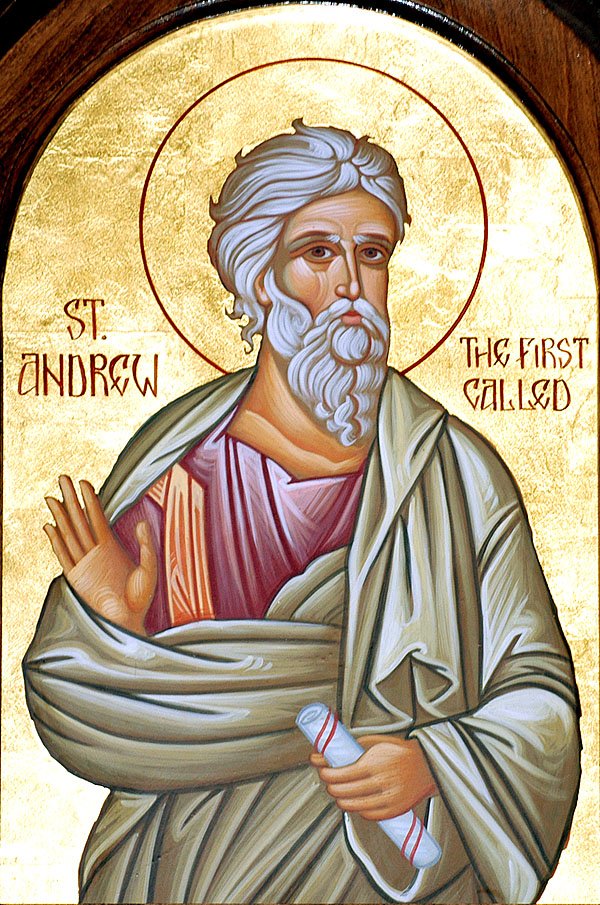
Holy Apostle Andrew the First Called
The Holy Apostle Andrew the First-Called was the first of the Apostles to follow Christ, and he later brought his own brother, the holy Apostle Peter, to Christ (John 1:35-42). The future apostle was from Bethsaida, and from his youth he turned with all his soul to God. He did not enter into marriage, and he worked with his brother as a fisherman.
The Holy Apostle Andrew the First-Called was the first of the Apostles to follow Christ, and he later brought his own brother, the holy Apostle Peter, to Christ (John 1:35-42). The future apostle was from Bethsaida, and from his youth he turned with all his soul to God. He did not enter into marriage, and he worked with his brother as a fisherman. When the holy Prophet, Forerunner and Baptist John began to preach, Saint Andrew became his closest disciple. Declaring Christ to be the Lamb of God, Saint John the Baptist himself sent to Christ his own two disciples, the future Apostles Andrew and John the Theologian.
After the Descent of the Holy Spirit upon the Apostles, Saint Andrew went to the Eastern lands preaching the Word of God. He went through Asia Minor, Thrace, Macedonia, he reached the River Danube, went along the coast of the Black Sea, through Crimea, the Black Sea region and along the River Dniepr he climbed to the place where the city of Kiev now stands.
He stopped overnight on the hills of Kiev. Rising in the morning, he said to those disciples that were with him: “See these hills? Upon these hills shall shine forth the beneficence of God, and there will be a great city here, and God shall raise up many churches.” The apostle went up around the hills, blessed them and set up a cross. Having prayed, he went up even further along the Dniepr and reached a settlement of the Slavs, where Novgorod was built. From here the apostle went through the land of the Varangians towards Rome for preaching, and again he returned to Thrace, where in the small village of Byzantium, the future Constantinople, he founded the Church of Christ. The name of the holy Apostle Andrew links the mother, the Church of Constantinople, with her daughter, the Russian Church.
On his journeys the First-Called Apostle endured many sufferings and torments from pagans: they cast him out of their cities and they beat him. In Sinope they pelted him with stones, but remaining unharmed, the persistent disciple of Christ continued to preach to people about the Savior. Through the prayers of the Apostle, the Lord worked miracles. By the labors of the holy Apostle Andrew, Christian Churches were established, for which he provided bishops and clergy. The final city to which the Apostle came was the city of Patra, where he was destined to suffer martyrdom.
The Lord worked many miracles through His disciple in Patra. The infirm were made whole, and the blind received their sight. Through the prayers of the Apostle, the illustrious citizen Sosios recovered from serious illness and Maximilla and Stratokles, the wife and brother of the governor of Patra, were healed. The miracles accomplished by the Apostle and his fiery speech enlightened almost all the citizens of the city of Patra with the true Faith.
Few pagans remained at Patra, but among them was the prefect of the city, Aegeatos. The Apostle Andrew repeatedly turned to him with the words of the Gospel. But even the miracles of the Apostle did not convince Aegeatos. The holy Apostle with love and humility appealed to his soul, striving to reveal to him the Christian mystery of life eternal, through the wonderworking power of the Holy Cross of the Lord. The angry Aegeatos gave orders to crucify the apostle. The pagan thought he might undo Saint Andrew’s preaching if he were to put him to death on the cross.
Saint Andrew the First-Called accepted the decision of the prefect with joy and with prayer to the Lord, and went willingly to the place of execution. In order to prolong the suffering of the saint, Aegeatos gave orders not to nail the saint’s hands and feet, but to tie them to the cross. For two days the apostle taught the citizens who gathered about. The people, in listening to him, with all their souls pitied him and tried to take Saint Andrew down from the cross. Fearing a riot of the people, Aegeatos gave orders to stop the execution. But the holy apostle began to pray that the Lord would grant him death on the cross. Just as the soldiers tried to take hold of the Apostle Andrew, they lost control of their hands. The crucified apostle, having given glory to God, said: “Lord Jesus Christ, receive my spirit.” Then a blazing ray of divine light illumined the cross and the martyr crucified upon it. When the light faded, the holy Apostle Andrew had already given up his holy soul to the Lord. Maximilla, the wife of the prefect, had the body of the saint taken down from the cross, and buried him with honor.
A few centuries later, under the emperor Constantine the Great, the relics of the holy Apostle Andrew were solemnly transferred to Constantinople and placed in the church of the Holy Apostles beside the relics of the holy Evangelist Luke and Saint Paul’s disciple Saint Timothy.
Troparion - Tone 4
O Andrew, as the First-called of the Apostles / and brother of their Leader, / entreat the Master of all / to grant peace to the world / and to our souls great mercy.
Kontakion - Tone 2
Let us praise Andrew, the divine preacher, / the namesake of courage, / the first-called of the Savior’s disciples / and the kinsman of Peter. / As he once called to his brother, now he cries out to us: / “Come, for we have found Him whom the world desires!”11 John 1:45
Scripture Readings
☩Epistle
1 Timothy 5:1-10
1
Rebuke not an elder, but intreat him as a father; and the younger men as brethren;
2
The elder women as mothers; the younger as sisters, with all purity.
3
Honour widows that are widows indeed.
4
But if any widow have children or nephews, let them learn first to shew piety at home, and to requite their parents: for that is good and acceptable before God.
5
Now she that is a widow indeed, and desolate, trusteth in God, and continueth in supplications and prayers night and day.
6
But she that liveth in pleasure is dead while she liveth.
7
And these things give in charge, that they may be blameless.
8
But if any provide not for his own, and specially for those of his own house, he hath denied the faith, and is worse than an infidel.
9
Let not a widow be taken into the number under threescore years old, having been the wife of one man,
10
Well reported of for good works; if she have brought up children, if she have lodged strangers, if she have washed the saints’ feet, if she have relieved the afflicted, if she have diligently followed every good work.
☩Gospel
Luke 19:37-44
37
And when he was come nigh, even now at the descent of the mount of Olives, the whole multitude of the disciples began to rejoice and praise God with a loud voice for all the mighty works that they had seen;
38
Saying, Blessed be the King that cometh in the name of the Lord: peace in heaven, and glory in the highest.
39
And some of the Pharisees from among the multitude said unto him, Master, rebuke thy disciples.
40
And he answered and said unto them, I tell you that, if these should hold their peace, the stones would immediately cry out.
41
And when he was come near, he beheld the city, and wept over it,
42
Saying, If thou hadst known, even thou, at least in this thy day, the things which belong unto thy peace! but now they are hid from thine eyes.
43
For the days shall come upon thee, that thine enemies shall cast a trench about thee, and compass thee round, and keep thee in on every side,
44
And shall lay thee even with the ground, and thy children within thee; and they shall not leave in thee one stone upon another; because thou knewest not the time of thy visitation.
Liturgical data sourced from OCA.org and orthocal.info